
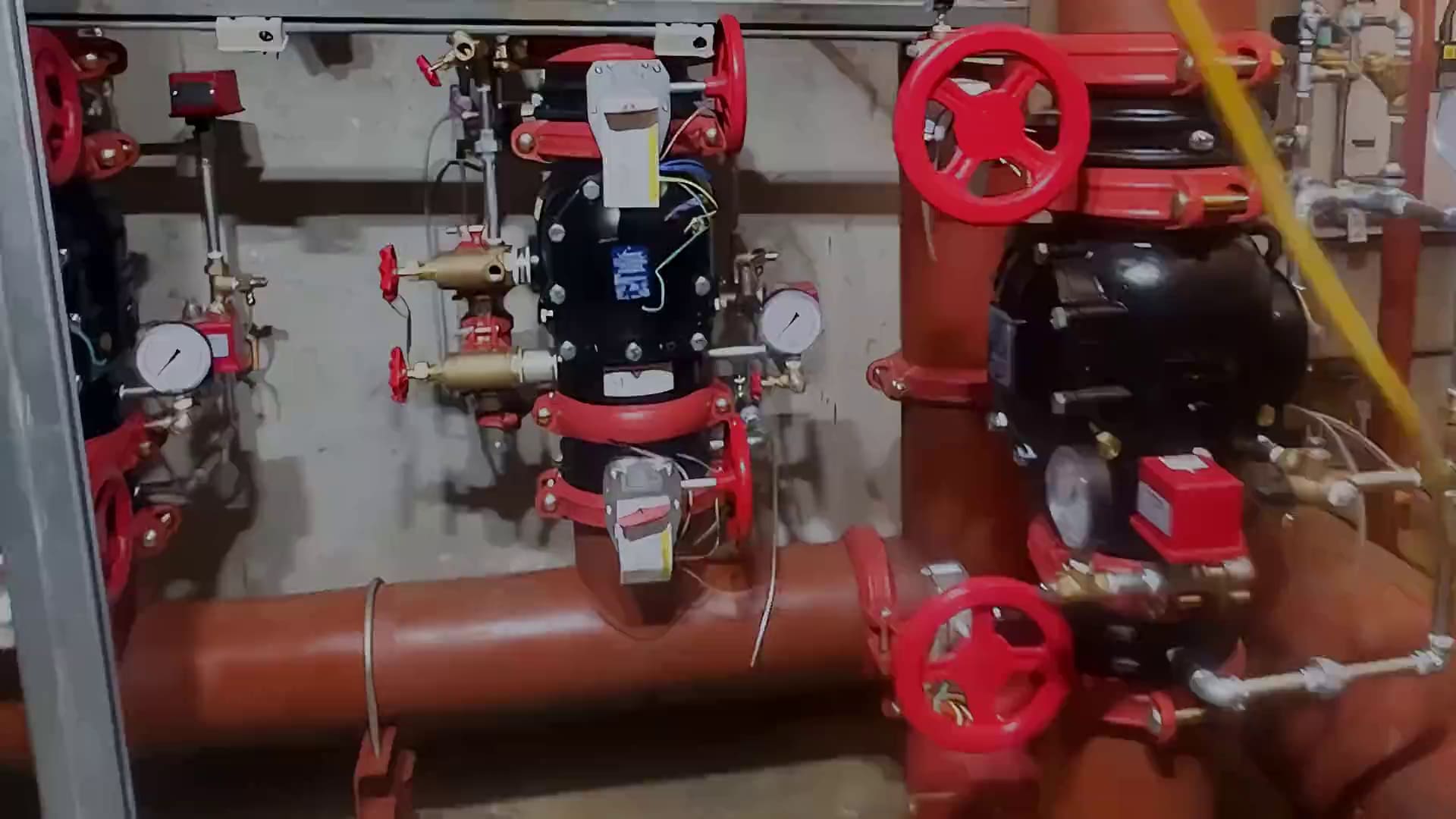
BS 9251:2021, the residential sprinkler standard
A new block above 11 metres, a care home refurbishment, or a fire risk assessment that named BS 9251 and left you looking it up.
BS 9251:2021 is the British Standard for fire sprinkler systems in homes and residential buildings. It is a life safety standard: the system controls a fire in the room where it starts so people can get out. It sorts buildings into four categories, from a single house to blocks over 18 metres. Sentry Sprinkler Protection installs and services residential sprinkler systems to BS 9251.
BS 9251:2021 Fire sprinkler systems for domestic and residential occupancies. Code of practice Published by BSI
What BS 9251 actually requires
BS 9251 and BS EN 12845 are not two versions of the same thing. They are built around different objectives, and that difference decides the design, the water supply and the maintenance regime. BS 9251 is the one that governs flats, care homes, student accommodation and houses, and since 2021 it treats every residential building over 18 metres as its own, stricter category.
-
Life safety, not property protection
A BS 9251 system is expected to control a fire in the room of origin and prevent flashover, so that the people in the building can get out or be rescued. A BS EN 12845 system is designed around protecting the building and its contents. Same trade, different objective, different design.
-
Four categories, and the category drives the design
The 2021 edition sorts buildings into four categories that scale with the building and the people in it, from a single house to every residential building over 18 metres. The category sets the design assumptions, how much water the supply has to hold and how much resilience sits around it. It is not one specification applied to every dwelling.
-
Category 4 is what changed in 2021
New in this edition, for residential buildings over 18 metres: a longer water supply, 60 minutes for each pump on a pumped system, back-up power, a standby pump, and a repeat alarm somewhere that is always staffed. A tower designed under the 2014 edition was not built to these.
-
Mixed use, and its own maintenance
Flats above shops or plant are normally protected to BS 9251 in the residential parts and BS EN 12845 in the rest. And a BS 9251 system does not inherit the commercial service schedule: a managing agent servicing it to BS EN 12845 is usually doing the wrong routine at the wrong interval.
The four BS 9251:2021 categories
| Category | Typical buildings |
|---|---|
| Category 1 | A single home: a house, a flat or a maisonette |
| Category 2 | Blocks of flats under 18 metres |
| Category 3 | Student accommodation, hostels, dormitories and larger care homes |
| Category 4 | Every residential building over 18 metres: longer water supply, back-up power, a standby pump and a remote alarm |
From Table 1 of BS 9251:2021, as summarised by BSI, BAFSA and CIBSE. Smaller care homes, HMOs and sheltered housing are placed by notes in the standard according to their size and layout, so check the building rather than the label.
Where it applies
- Blocks of flats, including new blocks over 11 metres under Approved Document B, and every residential building over 18 metres in Category 4
- Care homes and supported living
- Student accommodation, hostels and HMOs
- Individual houses, flats and maisonettes, including retrofits
Not sure whether this is the standard your building is held to?
It is a survey question rather than a paperwork one, and it is free. We read the specification and the policy rather than assuming the default.
What we do to this standard
- BS EN 12845 and BS 9251 Design and installation New systems, extensions and upgrades, designed, installed and commissioned. Fire sprinkler installation
- BS EN 12845 Sprinkler servicing The full BS EN 12845 routine, from the weekly gauge and alarm check to the annual service. Fire sprinkler servicing
- BS EN 12845 Sprinkler tanks The water supply behind the system, inspected, cleaned and replaced when it is past it. Sprinkler tank maintenance
BS 9251: questions
What is the difference between BS 9251 and BS EN 12845?
Objective. BS 9251 is a life safety standard for homes and residential buildings: it is designed to control a fire in the room where it starts so people can escape. BS EN 12845 is the commercial and industrial standard, designed around hazard classification and protecting the building and what is in it. They produce different designs, different water supplies and different maintenance regimes, so the first question on any residential job is which one actually applies.
Our block is over 11 metres. Does BS 9251 apply to us?
If it is a new residential block above 11 metres, Approved Document B expects sprinklers, and in the residential parts those are normally designed to BS 9251. Existing blocks are a different question and turn on the fire risk assessment and what the building has already. It is worth a survey rather than an assumption either way, because the answer changes what the building is required to hold.
Can the same contractor service both a BS 9251 and a BS EN 12845 system?
Yes, and on a mixed-use building it is usually better that one contractor holds both, because the two systems often share a water supply or a tank and the interaction between them is where things get missed. What matters is that each system is serviced to its own standard rather than one routine being applied to both.
Which version of BS 9251 is current?
BS 9251:2021, which replaced the 2014 edition. Its biggest change is Category 4 for residential buildings over 18 metres. If your system was designed under the older edition it does not automatically become non-compliant, but a change to the building, a change of use, or a fire risk assessment that flags the system are all good reasons to have the design checked against the current edition.
What are the four BS 9251:2021 categories?
Category 1 is a single home: a house, a flat or a maisonette. Category 2 is a block of flats under 18 metres. Category 3 covers buildings such as student accommodation, hostels, dormitories and larger care homes. Category 4 is every residential building over 18 metres. Smaller care homes, HMOs and sheltered housing are placed by notes in the standard according to their size and layout.
Is there a free BS 9251:2021 PDF?
Not a legitimate one. BS 9251 is a BSI publication under copyright and is sold through BSI Knowledge. Free copies online are usually pirated or the withdrawn 2014 edition, which has no Category 4. If what you need is what it asks of your own building, that is a free survey question: we go through the clauses that apply to you.
Worth reading next
- Compliance Sprinklers in blocks of flats: what the rules require In England, new blocks of flats above 11 metres must have sprinklers fitted. Residential systems are designed and maintained to BS 9251, which is a different standard from the commercial BS EN 12845.
- Compliance When does a UK building legally need sprinklers? In England, new blocks of flats over 11 metres must have sprinklers, and Wales requires them in almost all new homes. Beyond those thresholds, sprinklers are required by building control, by the fire strategy, or by an insurer rather than by a single national rule.
- Sprinklers How a fire sprinkler system actually works Each sprinkler head is held shut by a heat-sensitive glass bulb or fusible link, so only the heads directly over a fire open. The resulting flow drops the pressure in the pipework, which starts the pump and operates the alarm.
The published documents behind this page
We work to these. Where a figure on this page comes from one of them, this is where to check it.
- BS 9251Fire sprinkler systems for domestic and residential occupancies. Code of practice
The residential equivalent: blocks of flats, care homes, student accommodation and houses.
BSI
- Approved Document BFire safety: Approved Document B
Statutory guidance to Part B of the Building Regulations. Volume 1 covers dwellings, Volume 2 everything else, and it is where the height thresholds that trigger sprinklers and risers actually live.
UK Government
- BS EN 12845Fixed firefighting systems. Automatic sprinkler systems. Design, installation and maintenance
The standard commercial and industrial sprinkler systems are designed, installed and maintained to. It sets the weekly, monthly, quarterly and annual routines.
BSI
British Standards are copyright documents and most are bought rather than read free. We hold the ones we work to. If you need to know what one of them says about your building, ask us rather than buying it.
Certified, and audited on a schedule.
ISO 9001, certified by BRE Global and accredited by UKAS. Somebody independent audits how every job is planned, recorded and signed off, on a schedule.
ISO 9001:2015
Certified by BRE Global, accredited by UKAS
An audited quality management system. It means the way a job is planned, recorded and signed off is itself inspected by somebody independent, on a schedule.
Working to BS EN 12845, BS 9251 and BS 9990. If your insurer or fire risk assessor wants the certificates themselves, ring us and we will send them over.
Tell us the building. We will tell you what it is due.
No survey fee to find out where you stand. Describe the site and we will tell you which intervals apply and what the visit involves.
Request received
We’ve got it from here.
Step 1 of 5 is done. Here is how the rest goes.
- Request sent Done
- 2 We call you Next
- 3 Free survey
- 4 Fixed price
- 5 Work done